
The Grammar of Silence
Why the greatest filmmakers know exactly when to stop — and why most directors are terrified of that moment.
There is a scene in Satyajit Ray’s Charulata where Amal leaves, and Charu stands alone on a veranda. Ray does not cut. He does not score. He simply watches. The camera watches her watch the distance. For almost forty seconds, there is nothing — no dialogue, no swelling strings, no reaction shot to tell you how to feel. And in that nothing, everything.
Most filmmakers working today would have cut at five seconds. Their editors would have flagged it. Their producers would have asked, is something supposed to happen here? Something is happening. The audience is being invited to feel instead of being told what to feel. That is the difference between cinema and content — and it comes down to one of the most misunderstood tools in a director’s arsenal: silence.
Why Directors Fear the Pause
Fear of silence is almost universal among new filmmakers. It comes from a reasonable place: the anxiety of losing your audience. We are trained to believe that if the screen is not actively delivering information — dialogue, action, music — viewers will check their phones. So we fill. We score every scene. We cut before the moment can breathe. We post-produce silence into oblivion.
The irony is that this constant filling is precisely what makes films forgettable. When every emotion is underlined with music, the audience does not need to engage. They are spectators, not participants. Great cinema demands something different.
What the audience brings to a film is sometimes more powerful than what the filmmaker puts in it. — Robert Bresson
Bresson built his entire philosophy on subtraction. His actors were asked not to act — to simply be present, to do the minimum. The audience would complete the circuit. This terrified studios and enchanted viewers who were paying attention. He understood something that most filmmakers spend a career trying to learn: that silence is not the absence of meaning. It is a container for it.
The Scorsese Contradiction
Here is where it gets interesting. Martin Scorsese is famous for his music — for Gimme Shelter playing over the Copacabana tracking shot, for the Rolling Stones wall of sound in Goodfellas. He seems like the opposite of a Bresson. He is not.
Watch the scene in Raging Bull after Jake LaMotta loses to Robinson for the first time. Scorsese cuts the music entirely. The crowd noise drops to an ambient murmur. Jake stands in the ring, and the camera simply holds on his face. No score. No reaction cutaways. Just a man with nowhere to go. After the electric energy of the fight sequence, that silence lands like a physical blow.
This is Scorsese’s secret: he earns his silences. The musical density of his films makes the quiet moments extraordinary. Silence only works as a contrast. You cannot have a quiet scene in a quiet film — it just reads as uneventful. You need to build the noise so the silence has something to cut against.
Three Kinds of Silence
Not all silence is equal in cinema. Once you start studying it, you notice that the best filmmakers are deploying at least three distinct types.
Contemplative silence is Ray’s kind — the camera resting on a character who is thinking or feeling, giving the audience space to project. It slows time down. It is dangerous because it requires absolute trust in your actor and your frame. If either is weak, the scene dies.
Pregnant silence is a silence that is about to break — a silence loaded with what has not yet been said. Think of the scene in No Country for Old Men where Anton Chigurh sits across from a gas station owner and asks him to call a coin toss. The silences between their lines are almost unbearable. Every pause is a held breath. The Coens stretch these silences to the edge of discomfort because they know: discomfort is attention.
Empty silence is what you want to avoid — the pause that exists because the director did not know what to do next. It has no tension, no meaning, no accumulation. The audience feels it as confusion rather than invitation. The difference between this and contemplative silence is directorial intention. You must know why you are holding the moment — and that why must transmit through the frame.
A Practical Tool: Score Last
Here is one habit that changed how I work: lock your picture edit before you decide on music. Most filmmakers temp-track early — they drop in music to show producers and to guide the edit. The problem is you start cutting to the music. The music starts making decisions. By the time the composer arrives, the silence has already been filled, and pulling it back feels like loss even when it is gain.
If you edit first in genuine silence, you will discover which moments actually need music and which ones only seem to need it because you are uncomfortable. Silence has a texture. Learn to read it before you cover it.
The Digital Problem
There is a specific pressure that digital filmmaking and online distribution have created. Streaming platforms and algorithm-driven platforms penalize slow films. Pacing notes from distributors routinely flag scenes that hold too long. Short attention spans — whether real or assumed — have created an industry-wide reflex to cut faster, score everything, and eliminate pauses.
The filmmakers who resist this are making some of the most distinctive work in cinema right now. RaMell Ross’s Nickel Boys, Payal Kapadia’s All We Imagine as Light, Chaitanya Tamhane’s The Disciple — these are films that demand patience and reward it with something rare: the feeling that you have been inside another consciousness, not just been shown a sequence of events.
This is what silence enables. Not slowness for its own sake, but the space for a human being to be present on screen, and for another human being on the other side of the lens to meet them there.
The Challenge
Try this in your next project. Find one scene — just one — where you would normally score with underscore music, and instead, pull it out completely. Let the natural sound breathe. Let the actor hold the frame for three seconds longer than feels comfortable. Trust the image. Then watch it back a week later and ask yourself: did the silence say something the music would have buried?
It almost always does.
The grammar of silence is not mystical. It is a learnable craft — a skill of restraint and timing, of knowing when the audience’s imagination is doing better work than your production design. The directors who master it are not the ones who say the most. They are the ones who know exactly when to stop.
Ajinkya Nikam is a Mumbai-based filmmaker, cinematographer, and DIT with 13 years of experience across film and web series. He is currently developing his food and culture channel, Indian Food Lab. Follow his work at ajinkyanikam.com.
We’re a highly collaborative and supportive team, coming together on every project to ensure our clients get the very best result.

MEMOTION STUDIO
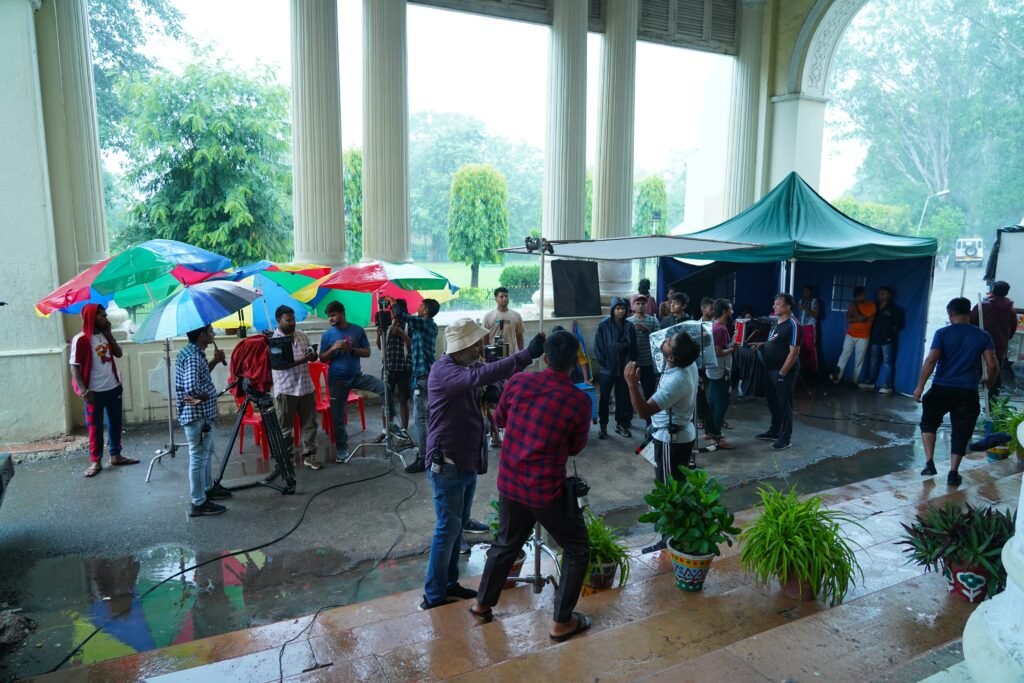
The Modern Problem: Content vs Cinema
Today, millions of videos are uploaded every day. Most are forgotten within hours. Why?
Because much of modern content is designed only to attract attention, not create emotion.
There is a difference between content creation and cinema.
Content tries to capture clicks.
Cinema tries to capture truth.
A filmmaker must ask difficult questions:
- Why does this character exist?
- What emotional conflict drives the story?
- What does this scene reveal about human nature?
- Why should the audience care?
Without emotional honesty, even visually beautiful films feel empty.
The Power of Real Human Experience
The strongest stories usually come from real observations.
A tired father returning home after work.
A student silently struggling with anxiety.
A child addicted to mobile phones.
A farmer waiting for rain.
A lonely old man watching the world change around him.
These are not “small” stories. These are universal emotions.
Audiences connect to authenticity more than perfection.
Many new filmmakers try to imitate trends instead of understanding life itself. But imitation creates temporary work. Observation creates timeless work.
Why Silence Matters in Filmmaking
Modern media is loud. Constant music, fast editing, endless dialogue, nonstop stimulation.
But silence is one of the most powerful cinematic tools.
Silence allows emotion to breathe.
Silence creates tension.
Silence allows audiences to think.
Some of the greatest scenes in film history are memorable not because characters spoke, but because they didn’t.
A filmmaker should never fear stillness.
The Responsibility of a Filmmaker
Cinema influences culture, emotions, politics, identity, and memory. Because of this, filmmaking carries responsibility.
A filmmaker can glorify violence — or expose its consequences.
A filmmaker can spread distraction — or create awareness.
A filmmaker can manipulate emotions — or reveal truth honestly.
Every frame communicates an idea.
That is why filmmakers must continuously grow not only technically, but emotionally and intellectually.
Reading literature, understanding economics, observing society, studying psychology, and experiencing real life are just as important as learning camera angles.
The Future of Filmmaking
Technology will continue evolving. AI tools, virtual production, and digital filmmaking will become even more powerful.
But one thing will never change:
Audiences will always search for emotional truth.
People forget visual effects.
People forget camera specifications.
But they remember how a film made them feel.
That is the real power of cinema.
Cinema Was Never About Technology Alone
If technology alone created masterpieces, then every person with a high-end camera would become a legendary director. But cinema history tells another story.
Satyajit Ray created emotionally powerful films with limited resources. Martin Scorsese built tension through character psychology and movement rather than visual effects. Many unforgettable films were created under restrictions — low budgets, difficult environments, or technical limitations.
What separated these filmmakers from others was not equipment. It was their ability to observe human life deeply.
A filmmaker notices silence.
A filmmaker notices fear hidden behind confidence.
A filmmaker notices loneliness inside crowded places.
Cinema is the art of seeing what others ignore.
